The Socratic Method: Common Side Effects
OR: Common Side Effects of Crossing Paths with Socrates

When you put on episode 2 of Common Side Effects (CSE) and the recap rolls: you get a microcosm of the show, in 4 questions.
1. What if there were a medicine that could heal like almost anything?
2. What if they didn’t want you to know about it?
3. What would happen if I brought this company a new product?
4. Can we meet up?
As discussed in my last on CSE, or as you may have gleaned from watching the show, or from an interview with the creators: the show is very of this moment. Which is all the more fascinating given they began working on the show in 2019.
All that to say, I feel quite comfortable scrutinizing this show deeply (and lovingly) because of how deeply (and lovingly) it seems people worked on it.
Ok, here comes the rabbit hole: the show itself is an example of the Socratic Method in practice. The most obvious clue? The main character’s pet tortoise, named Socrates.
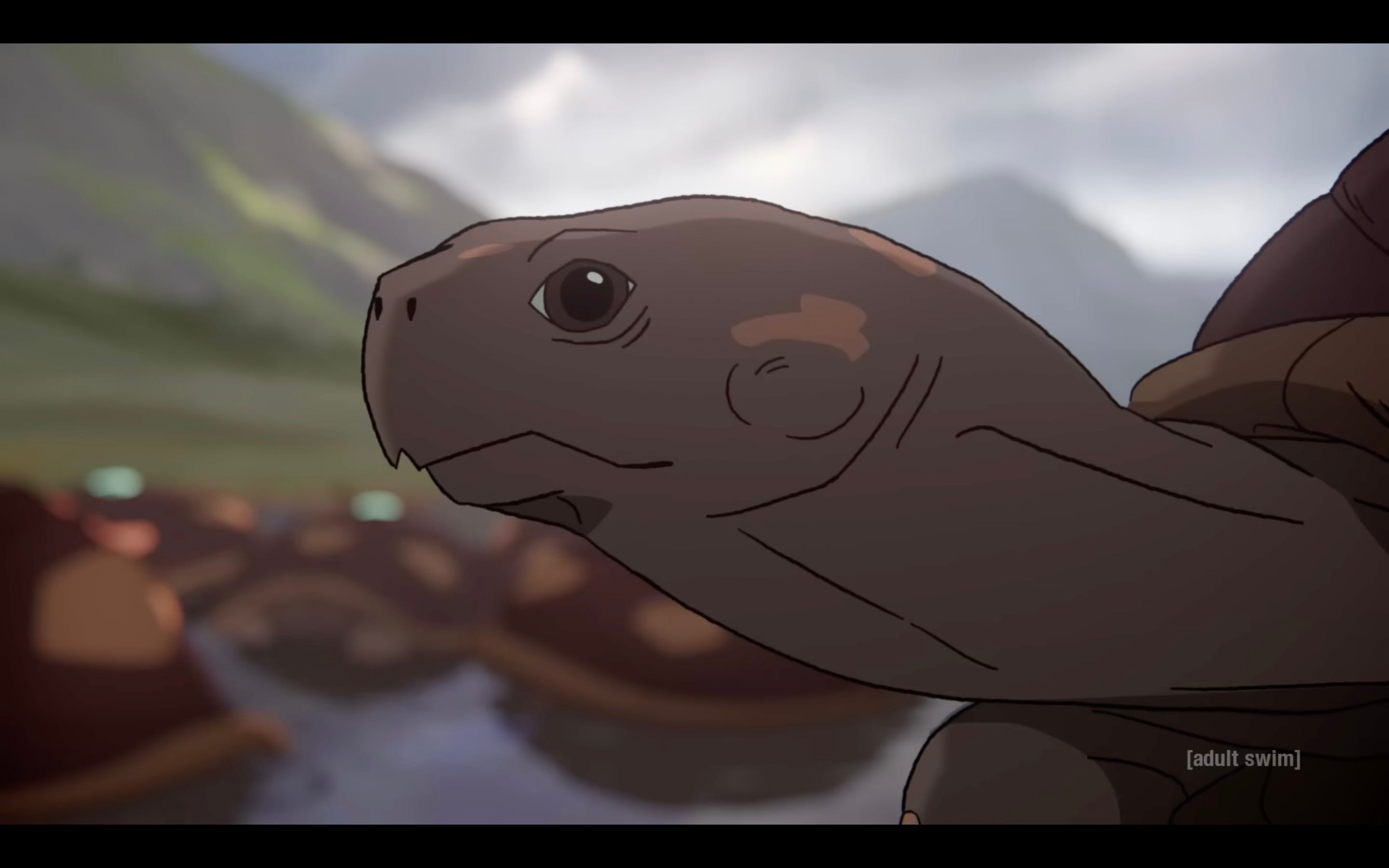
We first see Socrates in Peru, perhaps even before we see the mushroom. We watch Marshall explore Peru, the story he is recounting to Frances in the coffee shop. We see him come across a creep of tortoises (yes, that’s the term). Then, we focus in one specific tortoise. The tortoise moves to the center of our screen, pauses, then moves on determinedly. We the cut to an overhead view: of one tortoise, presumably the same, crossing the path between Marshall and the mushroom.
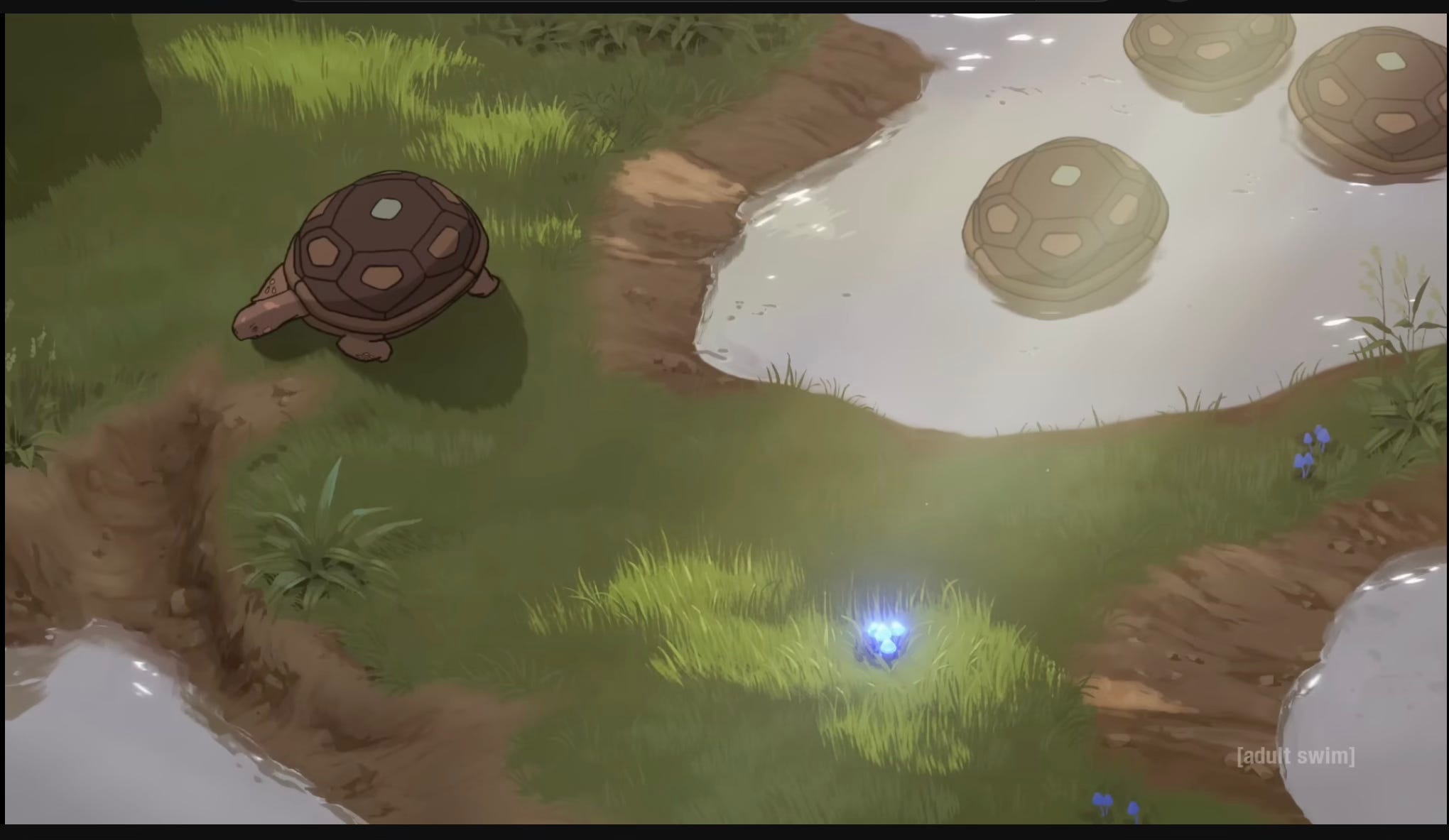
Marshall then sees the first mushroom, and pauses in awe. Notice one strap of his backpack still on. Next, he stoops down to the ground to examine the mushroom, eye to…fruiting body, and the strap on his shoulder is gone, and the backpack must be on the ground. Presumably, the tortoise we come to know as Socrates crawls in at this point.
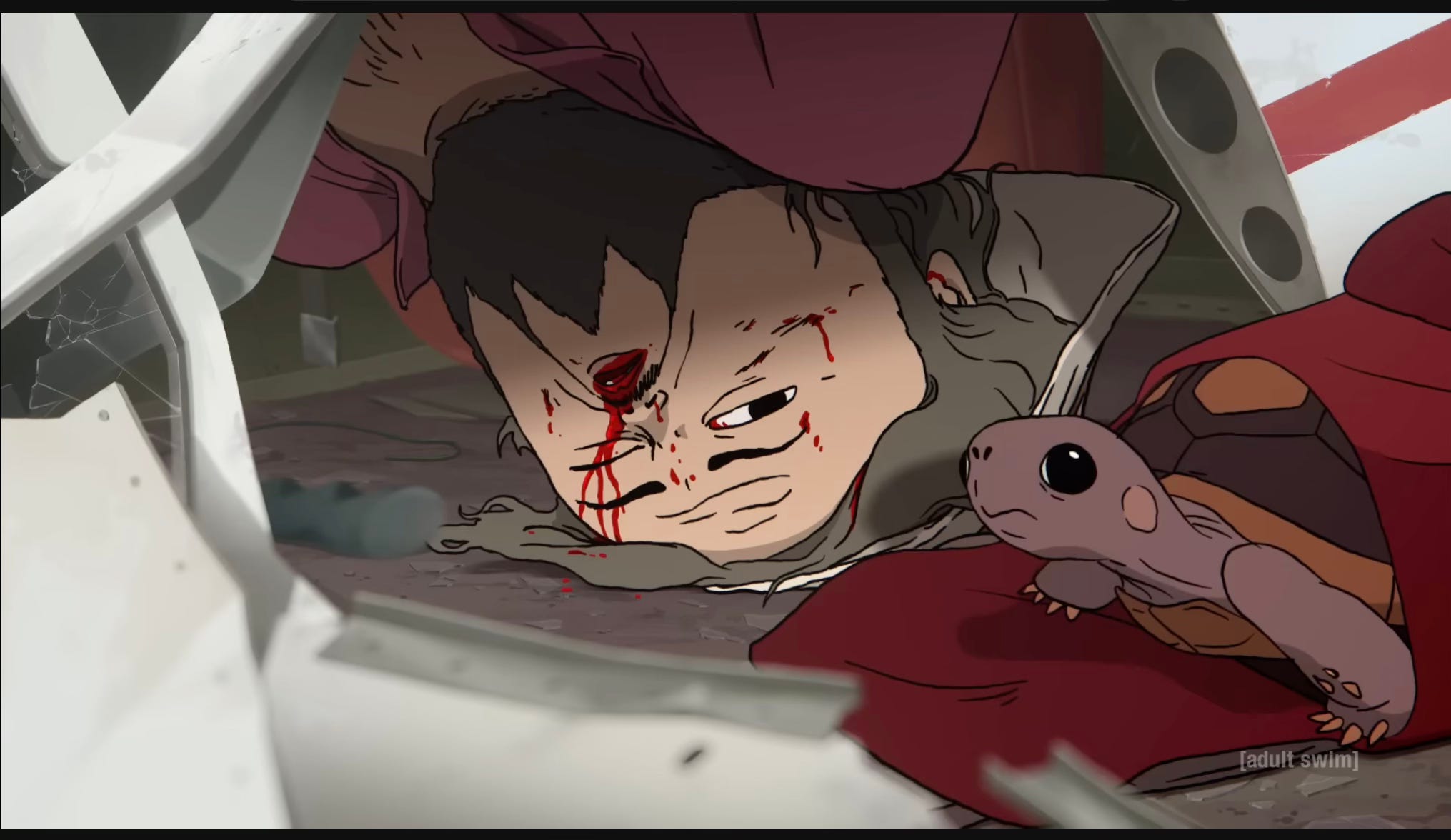
The show cuts back to the conversation in the coffeeshop. Soon, Marshall’s story gets to the part where he barely escaped Peru, in a plane crash with only a backpack. And, of course, he was saved from certain death by eating the mushroom. In the shot of the downed plane, Socrates crawls out of the backpack, and the voiceover adds, “... I also ended up with a pet tortoise.” Marshall may be talking about how he ended up with a tortoise named Socrates, but he could just as easily be referring to the mental burden of the mushroom. That burden takes the form of a question—or a series of questions—embodied by Socrates, the philosopher most associated with the idea of learning through questioning.
If you’re still with me, you are reasonably adept at descending a rabbit hole. Great, let’s go deeper. To further evidence my theory, I will show you how the 23 minutes of a carefully constructed pilot episode can be distilled into those 4 questions, and which may even largely define season 1—we’re only 6 episodes in.
This sounds outlandish: 23 minutes = 4 questions? But really, it isn’t. And it feels almost foolish to call this an observation. These four questions are exactly what the show uses to recap the pilot episode. And the pilot, of course, introduces us to the series and its series of questions.
The first two questions are from Marshall to Frances, asked during their conversation in the park, as replayed in the recap:
1. What if there were a medicine that could heal like almost anything?
And secondarily:
2. But, what if they didn’t want you to know about it?
These are the two central questions of the show: What if we found a magical cure-all? And what if the powers-that-be didn’t want us to know about it? In other words, what are the common side effects of a cure-all to society at large?
The other two questions build on these last two. Both of the primary questions are Marshall’s to Frances. It is important to remember who each character is in relation to each other, and their roles in the larger questions the series asks. Marshall is someone who chooses to live outside society. Frances, his old friend, is kind but has chosen to live in and according to society.
While many of the show’s most excited viewers identify with Marshall, the harsh reality for most of us is: we are not much like Marshall. Most everyone with an HBO/MAX subscription (or access to one) is living within society. We, the viewing public engaging with this show, are more like Frances than we are like Marshall. We are intrigued by someone like Marshall, we are open or susceptible to questioning things. But we are not living off the grid, and we are not sitting down and talking to open-shirted hippies in the park (mostly). So the questions Marshall asks Frances, he may as well be asking you, or us: the audience. Yes, the show may posit some answers, but starting the show with these questions makes it clear we are all on a quest, with questions.
The next question, the third, comes from Frances. It’s the logical follow-up to the first two, and one we must all ask ourselves as we consider the cure-all. Frances asks Rick Kruger, who, as CEO of Reutical, embodies the pharmaceutical industry: “What would happen if I brought this company a new product?” What would you do with the knowledge of a cure-all? Even if your goal was to benefit as many people as possible, what’s the right approach?
Anyone who encounters the mushroom encounters this question. And we, as the audience, must frequently face this question through the show. What would happen? What would we do?
The final question, the fourth, comes from Marshall to Frances: “Can we meet up?” This question, in effect, asks: Who can Marshall trust? And who would you trust?
The show offers us some answers, or possible answers, even 6 episodes in. But the Socratic method—like the show itself—is about more than just the answers. The defining feature of both is: the question.
Does it sound like my tinfoil hat is on too tight? Or are we on the same wavelength? Let me know what you think!